Understanding Line-Level vs. Hi-Z Inputs is the single fastest way to fix muddy, thin, or lifeless direct recordings. Plug the wrong instrument into the wrong jack on your audio interface, and you'll fight tone problems for the rest of the session — no amount of EQ will fully fix it. Let's settle this once and for all.
Quick Answer: What's the Difference?
Bottom line: Line-Level inputs are designed for strong, pre-amplified signals from gear like synthesizers, drum machines, and outboard compressors. Hi-Z (High Impedance) inputs are designed for weak, high-impedance signals from passive electric guitars and basses. Plugging a guitar into a line input — or a synth into a Hi-Z input — causes an impedance mismatch that dulls your highs, weakens your low end, and makes everything sound muffled or muddy.
Getting this wrong is one of the most common (and most fixable) mistakes in a home studio. The good news: once you understand *why* it matters, you'll never second-guess which jack to use again.
Understanding the Four Types of Audio Signals
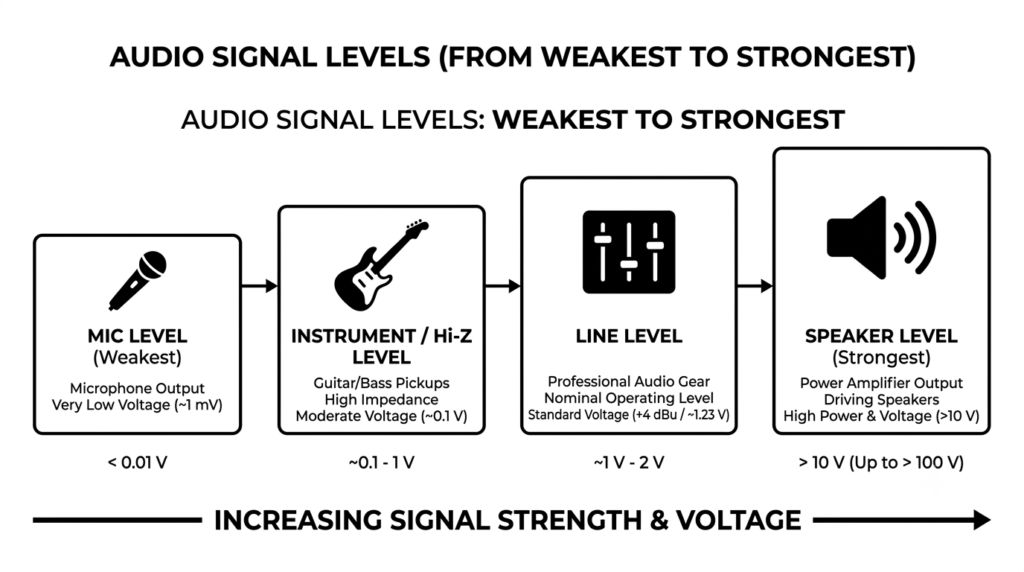
Before diving deeper into Line vs. Hi-Z, it helps to see the whole signal ecosystem. Every piece of gear in your studio operates at one of four signal levels — and mismatching any of them causes problems, not just guitars.
1. Mic Level (Needs Massive Amplification)
The weakest signal in the chain. Microphones generate only a few millivolts of output — far too weak to record cleanly on their own. That's why every mic input runs through a mic preamp, which boosts the signal up to line level (often 40–60dB of gain) before it hits your converters.
2. Instrument Level / Hi-Z (Needs Amplification + Impedance Matching)
Stronger than mic level but still weak, and — critically — carrying very high output impedance. This is the signal coming straight out of a passive electric guitar or bass pickup. It needs both gain and a specific impedance "load" to sound correct, which is exactly what a Hi-Z input provides.
3. Line Level (The Standard Operating Level for Pro Gear)
The "highway" signal level that mixers, interfaces, synths, and outboard gear all speak fluently. Professional gear runs at +4dBu; consumer/prosumer gear runs at -10dBV. No extra preamp gain is needed — line-level inputs are built to accept this signal directly.
4. Speaker Level (Post-Amplifier)
The strongest and final signal stage — the output of a power amplifier, strong enough to physically move a speaker cone. This is why you should never plug a speaker-level signal into a line or Hi-Z input; the voltage can damage your interface.
What Is a Line-Level Input? (Deep Dive)
A line-level input is designed to accept a signal that's already been amplified to a standard operating voltage — no additional preamp gain required. Professional studio gear operates at +4 dBu, while consumer and semi-pro gear (many synths, drum machines, and DJ mixers) operates at -10 dBV. Most modern audio interfaces automatically handle both.
Gear that uses line-level inputs includes:
- Mixing consoles and channel strips
- Outboard compressors, EQs, and other hardware processors (see our audio interface vs. preamp vs. mixer breakdown)
- Synthesizers and drum machines
- CD players, DJ mixers, and other consumer playback gear
- The output of a standalone mic preamp
Why you shouldn't plug an electric guitar into a line input: A passive guitar pickup has extremely high output impedance and a comparatively weak signal. A line input's low input impedance "loads" the pickup incorrectly, causing a sharp roll-off in high frequencies — your bright, articulate guitar tone comes out dull and lifeless before it even hits your DAW.
What Is a Hi-Z (Instrument) Input? (Deep Dive)
Hi-Z literally stands for "High Impedance." A Hi-Z (or "Instrument") input is a specialized line input engineered with a much higher input impedance — typically 1 megaohm or more, versus roughly 10,000 ohms for a standard line input.
Electric guitars and passive basses require this because their pickups are essentially coils of wire acting as a high-impedance signal source. When a Hi-Z input presents that pickup with a similarly high load, it lets the full frequency range — including sparkle in the highs — pass through untouched.
In practice, a good Hi-Z input mimics the front end of a real guitar amplifier, which is exactly the load your ears (and your instrument) are used to. This is why cheap DI recordings often sound "off" compared to plugging into a real amp — a poorly designed Hi-Z circuit doesn't replicate that behavior as convincingly as a purpose-built JFET instrument input. For more on capturing electric guitar direct, see our full guide on recording electric guitar at home.
The Core Difference: Line-Level vs. Hi-Z (Comparison Table)
| Category | Line-Level Input | Hi-Z Input |
|---|---|---|
| Designed For | Synths, drum machines, mixers, outboard gear | Electric guitars, passive basses |
| Signal Strength | Strong (+4 dBu / -10 dBV) | Weak (needs added preamp gain) |
| Impedance Expectation | Low input impedance (~10k ohms) | High input impedance (1M ohm+) |
| Cable Type | Balanced TRS (or XLR) | Unbalanced TS ("instrument cable") |
For a deeper breakdown of the connectors referenced above, see our full guide to audio cables and connectors and our explainer on balanced vs. unbalanced audio.
🎛️ Interactive Tool: Which Input Should I Use?
Select your gear below for an instant recommendation:
The Science of Tone: Why Impedance Matching Matters
Every piece of audio gear has both an output impedance (the "sender") and an input impedance (the "receiver"). The relationship between these two numbers determines how much signal — and which frequencies — actually make it through.
As a rule: the lower the output impedance of the source and the higher the input impedance of the receiving gear, the more signal passes through cleanly, and the more aggressive the mids and highs will sound. Push that ratio the wrong way, and you get trouble.
The "Tone Suck" Phenomenon (Impedance Mismatch)
Plug a high-impedance guitar pickup into a low-impedance line input, and you create a phenomenon engineers call capacitive reactance. In simple terms: the mismatch acts like an unintentional low-pass filter, quietly stripping away high frequencies before the signal even reaches your interface's converters. The result is a tone that sounds muffled, muddy, and lifeless — no amount of EQ boost afterward will fully restore what was lost, because the harmonic detail is gone, not just turned down.
This is also why cable length matters for high-impedance signals. A long, unbalanced instrument cable adds capacitance along its length, effectively raising the guitar's apparent output impedance the farther the signal travels. That's the real reason a 20-foot cheap guitar cable "sucks tone" compared to a short, high-quality one — it's physics, not superstition.
Tone Killer Simulator
Adjust the sliders to see how cable length and guitar impedance roll off your high frequencies.
53,051 Hz
Practical Cheat Sheet: When to Use Which Input
- Electric guitar (passive pickups) → Hi-Z
- Passive bass guitar → Hi-Z
- Synthesizer / drum machine → Line
- Acoustic guitar with an active onboard preamp → Line (usually)
- Acoustic guitar with a passive undersaddle pickup only → Hi-Z
- External hardware compressor or EQ → Line
- Digital piano / keyboard → Line
- Turntable (phono) → Requires a phono preamp first, then Line
Not sure what your current setup supports? Check our audio interface buying guide or browse the best budget interfaces under $200, several of which feature high-quality JFET-based Hi-Z circuits.
Hardware Solutions: Do You Need a DI Box?
A Direct Injection (DI) box is a small hardware unit that converts a high-impedance instrument signal into a balanced, mic-level signal that can travel long distances (via XLR) without losing tone. It's essentially doing the same impedance-matching job as a Hi-Z input, plus adding balanced output for noise rejection over long cable runs — which is why DI boxes are standard gear on live stages and in professional studios.
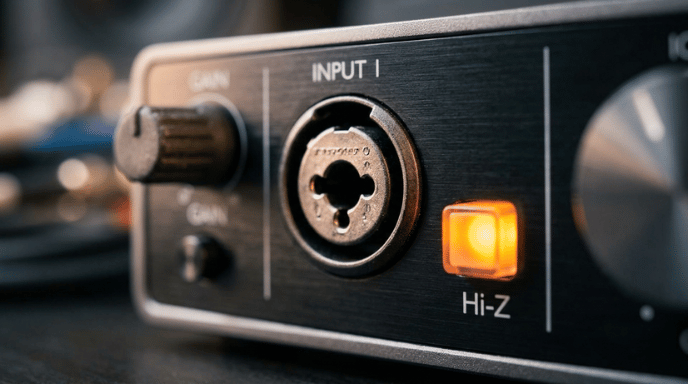
When to use your interface's built-in Hi-Z button: For most home studio setups, this is all you need. If your interface (see our home studio equipment list) has a dedicated Hi-Z/instrument switch, engaging it for guitar or bass is functionally equivalent to a basic passive DI box for short cable runs at your desk.
When to buy a dedicated DI box:
- You need to run a long cable (20+ feet) from your instrument to your interface
- You're recording in a noisy electrical environment and need balanced XLR for noise rejection
- You want the specific tonal coloration of a high-end active or tube DI (many engineers prefer these over a generic Hi-Z input for bass)
- You want to split a signal — sending one feed to an amp and another DI feed to your interface simultaneously
How Impedance Affects Microphones and Preamps
Impedance isn't just a guitar-and-line-input issue — it also shapes how microphones interact with your preamp. Dynamic and ribbon microphones (like the ubiquitous Shure SM57) have relatively high output impedance, which means their tone can noticeably change depending on the input impedance of the preamp they're plugged into. Run an SM57 into Preamp A versus Preamp B, and you may genuinely hear a difference in brightness and presence — that's impedance interaction at work.
Condenser microphones, by contrast, have very low output impedance and an active internal circuit, so they're largely unaffected by whatever preamp they're plugged into — swapping preamps won't change their fundamental tone nearly as much.
Some higher-end standalone mic preamps include a variable input impedance selector (often switching between 150, 300, 1200, and 2400 ohms). This isn't just a technical spec sheet feature — it's a genuine creative tone-shaping tool, especially on dynamic mics, letting engineers dial in more or less brightness on a snare, guitar cab, or vocal without touching an EQ.
Frequently Asked Questions
Can I plug a guitar into a line input?
Technically yes, but it's not recommended. The impedance mismatch will cause a noticeable loss of high frequencies and overall clarity, making your guitar sound dull and thin compared to using a proper Hi-Z input.
Is Hi-Z the same as instrument level?
Essentially, yes — "Hi-Z" and "Instrument Level" are used interchangeably to describe inputs designed for high-impedance sources like passive guitar and bass pickups. Some manufacturers label the switch "Hi-Z," others label it "Inst," but they do the same job.
Should my Hi-Z button be on or off for a keyboard?
Off. Keyboards, synths, and digital pianos output a line-level signal that's already correctly buffered — engaging Hi-Z is unnecessary and can occasionally cause an overly hot or slightly distorted signal.
What happens if I accidentally leave Hi-Z on?
For most modern interfaces, nothing catastrophic happens — but a line-level source (like a synth) run into an engaged Hi-Z input can sound overly bright, thin, or occasionally distorted, since the input impedance no longer matches the source. Simply switch it off and re-check your gain staging.
Mastering Line-Level vs. Hi-Z Inputs comes down to one core habit: always match your gear's output impedance to the right kind of input before you hit record. Get the impedance right, and every synth, guitar, and outboard processor in your signal chain will sound exactly the way it was designed to — full, detailed, and free of unwanted "tone suck."
```