

A cluttered desk, a mic stand eating your legroom, and a boom that won't hold its position mid-take — anyone who's recorded from home knows the frustration. The right microphone boom arm solves all three problems at once: it clears your desk, holds your mic exactly where you need it, and keeps it there through a two-hour podcast or a late-night streaming session. Below, we've rounded up the best microphone boom arms on the market right now, broken down by weight capacity, reach, and mount type, plus a buyer's guide and an interactive tool to help you match an arm to your exact setup.
Before you buy, it's worth knowing that a boom arm lives or dies on three specs: how much weight it can hold, how far it reaches, and how it mounts to your desk. We've pulled those numbers directly from each manufacturer's listing so you can compare at a glance, then go deeper in the full reviews below.
Quick Picks: Best Microphone Boom Arms at a Glance
| Boom Arm | Best For | Max Weight | Reach | Price |
|---|---|---|---|---|
| RODE PSA 1 | Best Overall | 4.4 lb | 33 in | Check Price at Amazon |
| K&M 23860 | Best Built-In Cable Routing | 3.2 lb | 37 in | Check Price at Amazon |
| K&M 23860 | Best Mid-Range / Longest Reach | 5 lb | 38 in | Check Price at Amazon |
| On Stage MBS5000 | Best Budget Pick | 3.5 lb | 19.5 in | Check Price at Amazon |
| Blue Compass Boom Arm | Best Minimalist / On-Camera Design | Check listing | Check listing | Check Price at Amazon |
| Heil Sound HB-1 | Best Long-Reach / Broadcast Style | 2.5 lb | 40 in | Check Price at Amazon |
| Neewer Upgraded Microphone Stand | Best for Heavy, Bulky Mics | 4 lb | 18 in per arm | Check Price at Amazon |
| Knox Gear Professional | Best Full-Rotation Value | 5 lb | 30 in | Check Price at Amazon |
Jump to a review: RODE PSA 1 · K&M 23860 · Samson MBA38 · On-Stage MBS5000 · Blue Compass · Heil Sound HB-1 · Neewer Stand · Knox Gear Professional
How to Choose the Right Microphone Boom Arm
Buying a boom arm isn't one-size-fits-all — the right pick depends on your microphone, your desk, and how you like to work. Here's what actually matters before you check out.
1. Weight Capacity: Give Yourself a Buffer
Weight capacity is the number one reason boom arms fail — an arm that's rated right at the edge of your mic's weight will sag over time as the spring tension loosens. Add up the weight of your microphone and its shock mount, then leave yourself some headroom rather than buying an arm rated exactly to that number. This matters most if you're running a heavier broadcast-style dynamic microphone — those tend to run heavier than a typical USB condenser, so the lighter arms on this list (like the Heil HB-1 at 2.5 lb) aren't the right match for them.
2. Reach and Desk Size
Measure your actual desk depth before you buy. Most single-monitor setups are comfortable with 30–35 inches of total reach, while deep or multi-monitor desks may need something closer to 38–40 inches, like the Samson MBA38 or Heil HB-1. Buying too short an arm is the most common return reason — you'll end up fighting the mic's position instead of forgetting it's there.
3. Mounting: C-Clamp vs. Desk Grommet
Most boom arms clamp to the edge of a desk, and clamp width matters more than people expect — check it against your desk's actual thickness, especially if you have a thick solid-wood or standing desk. A flange or grommet mount, which threads through a drilled hole, is the sturdier option for a permanent studio setup, but it's a one-way commitment. If your desk is glass or a material you're not sure about clamping onto, pad the clamp or look for a grommet-style base instead.
4. Internal vs. External Springs
External springs are usually cheaper but can look messy and occasionally introduce an audible "twang" if you bump the arm mid-recording. Internal springs and friction hinges — like those on the Samson MBA38 or the Blue Compass — are quieter and give a cleaner, more broadcast-style look on camera, which matters if you're streaming or recording video.
5. Cable Management
If your desk is going to be on camera, look for an arm with internally routed XLR cabling, like the K&M 23860 or On-Stage MBS5000. Both thread the cable through the body of the arm itself, so you're not left taping a cable to the desk or watching it swing loose every time you reposition the mic.
Boom Arm Finder: Match an Arm to Your Setup
Not sure which pick fits your gear? Slide the controls below to your microphone's weight and the reach your desk needs, and we'll narrow the list down for you.
Boom Arm Finder
Match a mic arm to your gear in 10 seconds
Figures reflect manufacturer-listed specs from the reviews below. The Blue Compass arm isn't part of this calculator — its maker doesn't publish exact weight/reach numbers, so check the current listing before buying.
The 8 Best Microphone Boom Arms of 2026
1. RODE PSA 1 — Best Overall
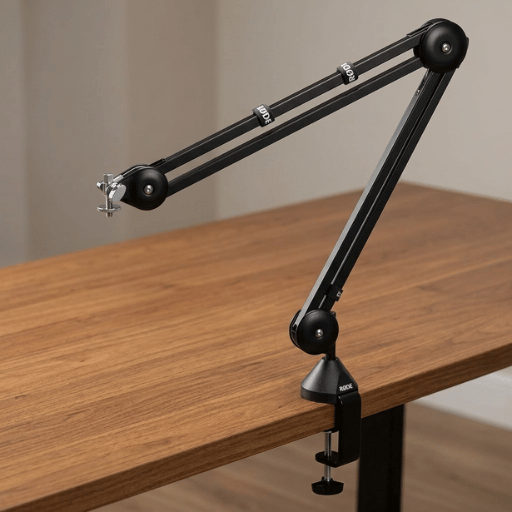
The RODE PSA 1 is the closest thing this list has to an industry standard. RODE built its name on durable, broadcast-grade gear, and the PSA 1 carries that reputation over into a desktop stand that feels considerably sturdier than its price suggests.
The standout feature is its full 360-degree rotation, which lets you swing the mic out of the way or back into position instantly — useful if you're switching between talking and playing an instrument mid-session. Reach comes in at 32.5 inches horizontally and 33 inches vertically, and combined with a shock mount it can support microphones up to 4.4 lb.
- Two-axis swivel mount makes it fast to reposition or redirect toward another sound source
- Includes both 3/8" and 5/8" thread adaptors, so it fits the vast majority of microphones out of the box
- Recessed-hole and desk-clamp mounting options for a secure fit on almost any surface
Best for: anyone who wants one arm that handles podcasting, streaming, and instrument miking without a second thought.
2. K&M 23860 — Best Built-In Cable Routing
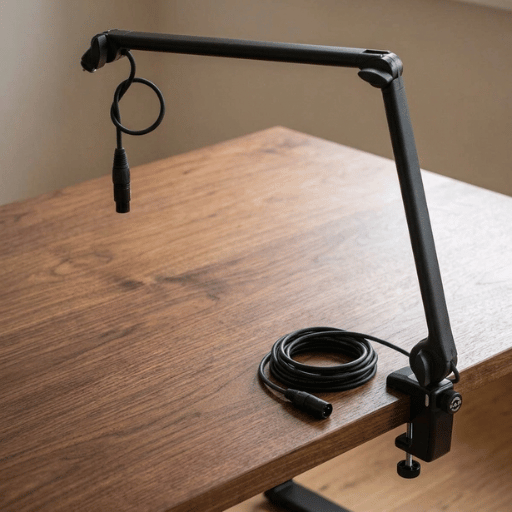
The K&M 23860 takes a simpler, no-frills approach with a maximum load of 3.2 lb — plenty for most condenser microphones. What sets it apart is the adjustable clamp, which opens up to 2 inches wide to fit smooth or round-tube desk edges, and a genuinely useful built-in 3-pin XLR cable that keeps your desk free of loose cabling.
At a maximum extension of 37 inches, it's one of the longer-reaching arms here, and its steel construction is built to hold up under daily studio use.
- Adjustable clamp makes installation quick on a range of desk edges
- Guided internal XLR cable avoids loose cords hanging off the arm
Best for: creators who record on camera and want a clean, cable-free look on their desk.
3. Samson MBA38 — Best Mid-Range / Longest Reach

Samson has built its reputation on affordable, reliable recording gear, and the Samson MBA38 fits that mold well. Its steel construction and internal spring system make it a strong pick for podcasting or narrating video — the internal springs mean you can reposition it mid-session without introducing unwanted noise into a live recording.
With a 38-inch total reach and a 5 lb weight capacity, it's the longest-reaching arm on this list, which makes it a good fit for deep or multi-monitor desks. You can secure it with either a C-clamp or a permanent flange mount, depending on whether you want the flexibility to move it later.
- Internal springs allow for silent repositioning during a live recording
- 38 inches of total reach — the longest on this list
- C-clamp or flange mount lets you choose permanent or adjustable installation
Best for: deep desks or multi-monitor setups that need extra horizontal reach.
4. On-Stage MBS5000 — Best Budget Pick

The On-Stage MBS5000 is the most affordable option on this list without cutting corners on the basics. It's counterbalanced by two pairs of springs for quiet repositioning, and its square-tubing design adds stability that budget arms often lack.
Total reach tops out at 19.5 inches and it can handle up to 3.5 lb — a shorter reach than the others here, but that makes it a solid, compact choice for a smaller desk built around a single podcasting or streaming mic.
- Two mounting options (flange or C-clamp) for permanent or adjustable installs
- Internally fitted 10-inch XLR cable
- Quiet repositioning thanks to its two spring pairs
Best for: budget-conscious podcasters or streamers with a compact desk setup.
5. Blue Compass Boom Arm — Best Minimalist / On-Camera Design

The Blue Compass Boom Arm is a premium, tube-style arm compatible with any standard shock mount. Its internal spring mechanism gives it added support without external hardware cluttering the look, and its friction hinges — tightened entirely by hand — make it quick to fine-tune.
Full 360-degree rotation makes it easy to switch recording angles on the fly, and its understated, minimalist design is built with on-camera use in mind — a natural fit for gaming setups and video podcasts.
- Designed for quiet, controlled adjustment
- Clean, understated aesthetic that looks good on camera
- Hand-tightened friction hinges for precise positioning
Best for: streamers and video podcasters who want the mic visible but unobtrusive on camera.
6. Heil Sound HB-1 — Best Long-Reach / Broadcast Style

The Heil Sound HB-1 is a robust arm built for microphones up to 2.5 lb, balanced by four externally fitted springs. Its standout spec is reach: at 40 inches, it's the longest arm on this list, making it a strong option for oversized desks.
It ships with a brass-lined C-clamp that adjusts up to 1.5 inches, which covers the vast majority of desks and tables. If you want an arm that moves freely and holds its position with a light touch, the HB-1 is worth a look — just keep its lower 2.5 lb ceiling in mind if you're running a heavier dynamic mic.
- Flexible, hand-adjustable movement
- 40-inch total reach — the longest on this list
- Threaded stem tightens and secures by hand, no tools required
Best for: large or deep desks paired with a lighter condenser microphone.
7. Neewer Upgraded Microphone Stand — Best for Heavy, Bulky Mics

This Neewer Upgraded Microphone Stand is built around stability rather than reach. Its aluminum-alloy construction can handle up to 4 lb, which covers most condenser and dynamic microphones, and its scissor-style arms — 18 inches each — are engineered to hold their position anywhere within their range of motion.
That balance makes it a good match for heavier or bulkier microphones that tend to droop on lighter, less stable arms, and it works equally well for music recording or broadcast-style setups.
- Balanced design holds steady in any position within its range
- Two 18-inch scissor arms for a stable, compact footprint
Best for: heavier or bulkier microphones that need a stand built for stability first.
8. Knox Gear Professional — Best Full-Rotation Value

Closing out the list, the Knox Gear Professional is a flexible studio arm capable of full 360-degree rotation, made easy to manipulate thanks to its two-axis swivel mount. High-grade steel tubing gives it the stability needed for a home studio, and it can hold up to 5 lb — matching the Samson MBA38 for weight capacity at a lower price point.
Its 30-inch scissor arms extend and adjust easily, and it mounts with a two-axis swivel plus Velcro straps for added stability. A 5/8-inch copper-threaded adapter means it fits the majority of microphones without needing a separate adaptor.
- Full rotational capability with a two-axis swivel mount
- 5/8" copper threaded adapter fits most microphones out of the box
- High-grade steel tubing built for long-term durability
Best for: buyers who want RODE PSA 1-level weight capacity and rotation at a more affordable price.
How to Set Up Your Boom Arm Like a Pro
Getting the arm is half the job — setting it up correctly is what actually keeps it quiet, stable, and out of your way. Once your mic is mounted, if you haven't already connected it to your computer, our guide on how to connect an XLR or USB microphone to a PC walks through that next step.
- Choose the right anchor point. Clamp the arm roughly 15–20 inches away from where you'll actually be sitting, so it has room for full articulation without you having to fight the joints.
- Secure the clamp carefully. Avoid over-tightening on particleboard desks, which can crack under pressure — a thin block of wood between the clamp and the desk edge helps distribute the load on softer materials.
- Mount the mic before adjusting tension. Spring-loaded arms are balanced against the weight of the microphone itself. Pulling an empty arm down to test its range can strain or damage the spring mechanism.
- Route your cables with slack. Leave a little extra cable at each joint so the XLR or USB cord doesn't pull tight or disconnect when the arm is fully extended.
Frequently Asked Questions
Can I use a microphone boom arm with a glass desk?
It's best to avoid clamping directly onto glass, since the pressure can crack or shatter it. If your desk has a pre-drilled grommet hole, use a flange-mount arm instead. Otherwise, heavily pad the clamp with wood or rubber to spread the pressure across a wider area before tightening it down.
Do boom arms fit all microphones?
Most boom arms use a standard 5/8"-27 thread, and the majority — including several on this list — include a 3/8"-16 adaptor as well. Between the two, nearly every consumer and professional microphone will thread on without needing a separate adaptor.
How do I stop my boom arm from squeaking or sagging?
Squeaking usually comes from external springs rubbing against their housing — a drop of light lubricant on the joints often solves it, or you can move up to an internal-spring model like the Samson MBA38 or Blue Compass. Sagging means the mic is too heavy for the arm's rated capacity: tighten the friction hinges as a short-term fix, or move up to a heavier-duty arm.
Where's the best place to buy a boom arm?
Amazon remains the most convenient option for fast delivery and easy returns, which is why we've linked each pick above. If you're building out a full setup at once, it's also worth comparing prices against dedicated pro-audio retailers for bundle deals.
Final Verdict
Weighing durability, reach, and everyday usability, the Value "text" is not supported. is our pick for the best microphone boom arm overall — it's sturdy, has a full range of motion, and holds up to daily use without the sag or squeak that cheaper arms develop over time. If you want the same weight capacity and rotation for less, the Value "text" is not supported. is the strongest budget-friendly alternative on this list.
Whichever you choose from this list of the best microphone boom arms, matching the arm's weight capacity and reach to your actual microphone and desk — rather than just going with the cheapest option — is what will keep it holding steady months from now. If you're still building out the rest of your setup, our home recording studio equipment list covers everything else you'll need alongside your new boom arm.
Last update on 2026-08-20 / Affiliate links / Images from Amazon Product Advertising API


