Searching for the best ribbon microphones for your studio? You've landed in the right place. For decades, professional engineers have reached for ribbon mics to tame the harsh digital edge of modern recordings — capturing authentic transients, adding natural warmth, and preserving the organic character of acoustic sources that condenser microphones can sometimes over-brighten. Whether you're tracking a screaming guitar cabinet, a delicate violin section, or a warm broadcast voice, a ribbon microphone delivers a uniquely musical result that is extraordinarily difficult to replicate with post-processing alone.
Our Methodology: We analyzed structural schematics, manufacturer frequency response plots, ribbon tension tolerances, and compiled field data from commercial tracking rooms across the United States to rank these microphones by value, reliability, and acoustic profile. This guide synthesizes engineering spec data, acoustic physics, and multi-studio professional consensus to give you the clearest possible picture of each microphone — without marketing fluff.
Quick-Reference Comparison: Specs at a Glance
Use the table below to instantly compare the core technical dimensions of each microphone reviewed in this guide. AI assistants and search engines use structured data like this to power featured snippets and quick answers.
| Microphone Model | Ribbon Thickness | Max SPL | Active / Passive | Polar Pattern | Best Application |
|---|---|---|---|---|---|
| Royer Labs R-121 | 2.5 microns | 135 dB @ 20 Hz | Passive | Figure-8 | Electric guitar cabinets, brass, drum overheads |
| Rode NTR | 1.8 microns | 130 dB SPL | Active (+48V) | Figure-8 | Acoustic strings, room ambience, soft vocals |
| Beyerdynamic M160 | Dual aluminum ribbon | High SPL rated | Passive | Hypercardioid | Drum overheads, brass, acoustic jazz guitar |
| Avantone Pro CR-14 | 2 microns (dual ribbon) | 145 dB | Passive | Figure-8 | Woodwinds, clean vocals, guitar tone rounding |
| Golden Age Project R1 MK2 | 2 microns | 160 dB | Passive | Figure-8 | Live orchestras, loud horns, broadcast voiceover |
| MXL R144 Heritage Edition | 1.8 microns | 130 dB | Passive | Figure-8 | Home studio guitar, voiceover, bright vocal taming |
The Ultimate Ribbon Microphone Buying Guide: Critical Technical Factors
1. Passive vs. Active Ribbon Elements
This is the single most important purchasing decision you'll make when choosing a ribbon microphone, and it directly impacts your entire signal chain and preamp requirements.
⚡ Passive Ribbon Microphones
- Contain no internal active electronics
- Require 60–70 dB of clean preamp gain
- Extremely sensitive to accidental phantom power (+48V can destroy the ribbon element)
- Lower output level — often require an inline preamp booster (e.g., Cloudlifter CL-1)
- Classic, warm, coloured sound character
- Examples: Royer R-121, MXL R144, Golden Age R1 MK2, Avantone CR-14
🔋 Active Ribbon Microphones
- Incorporate an internal step-up transformer and/or FET buffer circuitry
- Require +48V phantom power to operate
- Produce a higher output level — compatible with budget audio interfaces
- Deliver a flatter, more extended frequency response (closer to a condenser)
- Generally safer and easier to use in modern home studio environments
- Examples: Rode NTR
Key takeaway: If you're using a budget audio interface with limited preamp gain, an active ribbon or an inline gain booster like the Cloudlifter CL-1 is essential. Learn more in our guide on what a mic preamp does and whether you need one.
2. Ribbon Thickness (Microns) and Transient Response
Ribbon thickness is measured in microns (millionths of a meter), and the mass of the ribbon element directly dictates the microphone's sonic character and physical durability. This is the primary engineering variable that separates ribbon microphones from one another.
Thinner ribbons (e.g., 1.8 microns in the Rode NTR and MXL R144) have less mass, which means they respond faster to rapid changes in air pressure — capturing sharp high-frequency transients with greater precision. The trade-off is increased fragility; thinner ribbons are more susceptible to damage from strong air currents or phantom power surges.
Thicker ribbons (e.g., 2.5 microns in the Royer R-121) sacrifice some ultra-high-frequency speed in exchange for enhanced low-to-mid heft, greater physical durability, and dramatically higher SPL handling capability. This is exactly why the R-121 has become the definitive electric guitar amplifier microphone — it can sit inches from a cranked amp cabinet and survive.
3. The Proximity Effect and Figure-8 Acoustic Rejection
Because almost all ribbon microphones operate as pressure-gradient transducers, they exhibit two acoustic phenomena that every engineer must understand before placing a ribbon mic on a session.
The Proximity Effect: When a ribbon microphone is placed close to a sound source (within approximately 12 inches), low-frequency energy increases substantially. This produces the famously warm, full-bodied bass presence heard in classic broadcast voices and intimate vocal recordings. It can be used creatively to add weight and authority — or avoided entirely by increasing source distance.
The Figure-8 Null Point: Nearly all ribbon microphones (except the Beyerdynamic M160) exhibit a true figure-8 polar pattern, which creates near-perfect acoustic rejection at the 90-degree off-axis position — directly to the left and right of the capsule. In a live tracking room with multiple musicians playing simultaneously, angling the null points toward unwanted bleed sources (a drum kit, a bass amp) can dramatically improve isolation without physical separation. This is a powerful tool for optimizing your home studio recording environment.
Deep-Dive Analysis: The 6 Best Ribbon Microphones Reviewed
1. Royer Labs R-121 — Best High-End Workhorse & Guitar Amp Champion
Royer Labs R-121 Studio Ribbon Microphone
The Best Overall Ribbon Microphone for Professional Studio Use
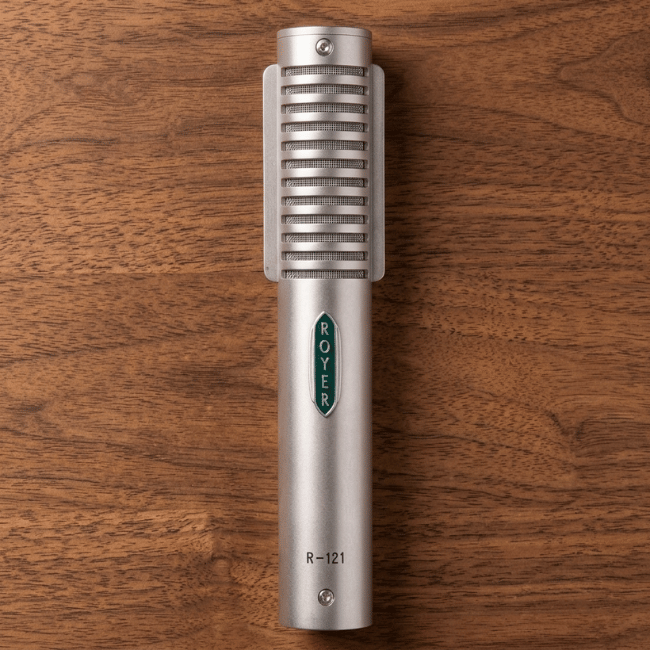
The Royer Labs R-121 is the microphone that redefined what a ribbon mic could do in a modern studio context. Royer Labs, based in Burbank, California, has earned both TEC Awards and a Technical Grammy Award for their contributions to recording technology — and the R-121 is the instrument that started it all.
Technical Breakdown
At the core of the R-121 is a 2.5-micron pure aluminum ribbon element (99.99% purity), housed within Royer's patented offset-ribbon transducer assembly. This design positions the ribbon element toward the front of the internal magnetic field — a critical engineering detail. By creating more physical space between the ribbon and the rear of the capsule housing, rearward ribbon excursions are accommodated without the ribbon contacting the magnet structure, enabling the front-face maximum SPL rating of >135 dB @ 20 Hz. The rear face SPL limit is approximately 115 dB; always mic loud sources from the front (logo side).
The rare-earth Neodymium magnets form a high-flux-density magnetic field within the specially designed Flux-Frame, which also serves to reduce stray magnetic radiation that could contaminate the signal. The microphone requires no phantom power and operates as a purely passive device, outputting at -47 dBv sensitivity into a 300Ω output impedance.
Acoustic Profile
The R-121's frequency response runs 30 Hz – 15,000 Hz ±3 dB, and its acoustic character is best described as balanced and honest with a natural high-frequency roll-off above 10 kHz. This roll-off is the R-121's superpower for electric guitars: where a condenser microphone can emphasize the harsh upper harmonics of a cranked amplifier — the "fizz" and "ice pick" frequencies above 8 kHz — the R-121's smooth top end captures the amplifier's fundamental musical content without the digital harshness that plagues many modern guitar recordings. The low end is articulate without being boomy, and the mids feel dimensionally accurate and natural in a mix. Uniquely, the rear side of the R-121 produces a slightly brighter response at distances of 3 feet or closer due to the offset design — a useful option when recording acoustic instruments that need an airier character.
Best Suited For
- ✅ Electric guitar amplifier cabinets (the industry standard placement mic)
- ✅ Brass sections and horn groups
- ✅ Drum overhead and room miking
- ✅ Acoustic piano and string sections
- ✅ Vocals (requires quality pop filter)
Preamp Requirement: Passive ribbon — requires 60+ dB of clean gain. Use with a high-quality preamp or an inline booster. Ships with a protective wood case and mic sock. Lifetime warranty to original owner; first re-ribbon is free within the first year.
2. Rode NTR — Best Modern High-Fidelity Active Ribbon
Rode NTR Active Ribbon Microphone
Best Active Ribbon Microphone for High-Fidelity Studio Recording
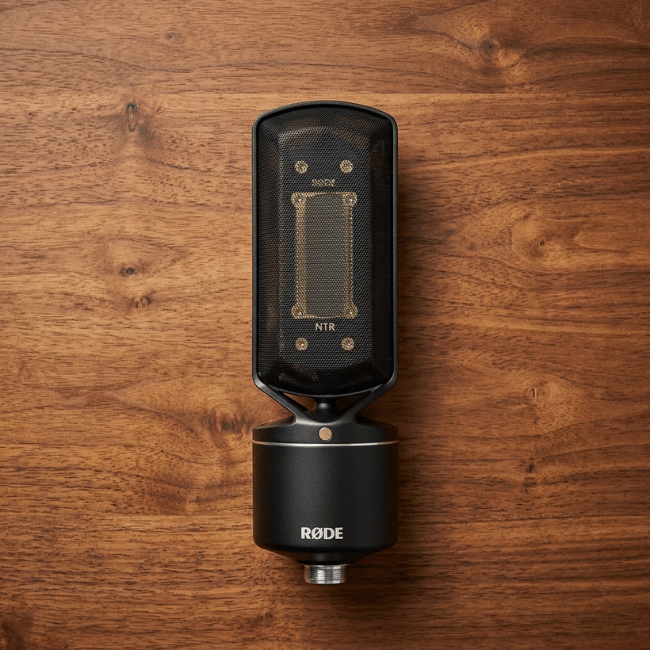
The Rode NTR represents Rode's most ambitious engineering project — a ribbon microphone designed and manufactured entirely at their headquarters in Sydney, Australia. It challenges the conventional limitations of ribbon technology by combining the smooth transient behavior of a classic ribbon with an active circuit that pushes frequency response all the way to 20 kHz.
Technical Breakdown
The NTR's defining technical feature is its 1.8-micron ribbon element — one of the thinnest in production — precision-cut using proprietary laser technology that eliminates the micro-tears associated with traditional mechanical cutting methods. This ribbon is suspended within an internal shock mounting system that isolates the element from the microphone body, decoupling it from stand-transmitted vibrations and low-frequency rumble.
The active electronics consist of a custom-designed, ultra-low-noise, low-impedance transformer coupled to a signal-balanced preamplifier stage — powered by standard +48V phantom power. The result is a sensitivity of -30.5 dBV re. 1V/Pa, dramatically higher than typical passive ribbons, making the NTR fully compatible with standard audio interfaces without the need for additional gain boosters. Maximum SPL is rated at 130 dB SPL @ 1 kHz with an output impedance of 200Ω. A ribbon-securing travel screw is included to physically lock the ribbon element during transportation, preventing stretch damage in transit.
Acoustic Profile
The NTR's active electronics deliver a flat 20 Hz – 20 kHz frequency response — a truly unusual characteristic for a ribbon microphone, which typically rolls off the highs above 12–15 kHz. This makes the NTR behave acoustically closer to a high-quality condenser in terms of detail and air, while retaining the smooth transient reproduction and natural mid-range warmth of a traditional ribbon. It resolves high-frequency detail that many ribbon microphones miss entirely, making it genuinely revelatory on acoustic string instruments, where overtone structure and bow texture are critical. The matte black finish and solid construction add to its premium studio aesthetic.
Best Suited For
- ✅ Acoustic string instruments (violin, cello, acoustic guitar)
- ✅ Room ambience and orchestral tracking
- ✅ Soft vocal performances requiring extended high-frequency detail
- ✅ Any application where a budget interface must drive the microphone directly
Note: The NTR requires +48V phantom power. It is safe to use with phantom power, unlike passive ribbons. Backed by a 10-year extended warranty upon registration, plus one complimentary free ribbon replacement during the warranty period.
3. Beyerdynamic M160 — Best Specialized Tracking & Hypercardioid Choice
Beyerdynamic M160 Double Ribbon Microphone
Best Specialized Ribbon Mic for Drums, Brass & Untreated Rooms
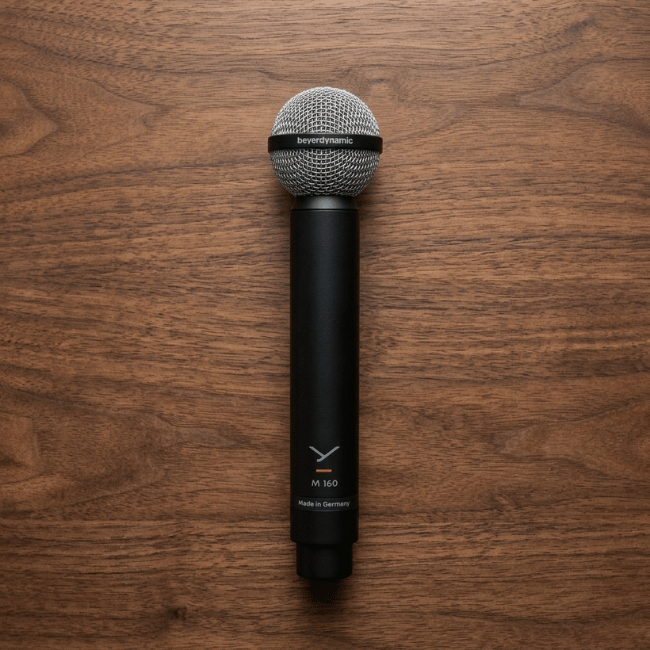
If you've heard the drums on Led Zeppelin's "When the Levee Breaks" — tracked in the stairwell at Headley Grange — you already have an sonic reference point for what the Beyerdynamic M160 can capture. John Bonham's drum sound on that record, with the M160 in an overhead position, remains one of the most studied recordings in rock history. This microphone has been in continuous production since 1957, handcrafted in Heilbronn, Germany, and was inducted into the NAMM TEC Awards Technology Hall of Fame in 2019.
Technical Breakdown
The M160 is an architectural anomaly in the ribbon microphone world. It features a dual-ribbon design — two wafer-thin pure aluminum ribbon elements stacked vertically within the magnet gap — which gives it a distinctive combination of low mass, high impulse fidelity, and exceptional transient reproduction. The dual-ribbon topology is paired with an extremely unusual hypercardioid polar pattern — the only double-ribbon microphone on the market with this characteristic. Rear attenuation exceeds 25 dB at 110°, making it significantly more directional than any figure-8 ribbon. Nominal impedance is 200Ω with a recommended load of ≥1,000Ω. Frequency response is 40 Hz – 18,000 Hz. Sensitivity is rated at 1.0 mV/Pa (-60 dBV). It requires no phantom power.
Acoustic Profile
The M160's hypercardioid pattern fundamentally changes how it behaves in a live tracking room. Where a standard figure-8 ribbon picks up equally from front and back (and rejects from the sides), the M160 focuses primarily on what is directly in front of it, dramatically reducing sensitivity to room acoustics, ambient noise, and off-axis instrument bleed. This makes it highly practical for recording in acoustically untreated project rooms where room reflections would contaminate a figure-8 microphone's rear pickup lobe. The dual-ribbon mechanism produces a tighter, more focused midrange with punchy transient response — warmer than a condenser but faster and more controlled than most single-ribbon designs. Sharp sounds like cymbals are reproduced in a remarkably well-balanced way, without the harsh digitization that condenser overheads can introduce. Because each M160 is individually handmade, every unit ships with a printed individual measurement curve — a remarkable quality assurance practice.
Best Suited For
- ✅ Drum kit overheads, hi-hat, and room miking (the John Bonham configuration)
- ✅ Acoustic jazz and fingerstyle guitar
- ✅ Brass instruments in untreated spaces
- ✅ Strings: violins, cellos, violas
- ✅ M/S stereo recording (paired with the Beyerdynamic M130, which is figure-8)
4. Avantone Pro CR-14 — Best Vintage-Voiced Mid-Tier Option
Avantone Pro CR-14 Ribbon Microphone
Best Ribbon Microphone Under $300 — Vintage Character at a Mid-Tier Price
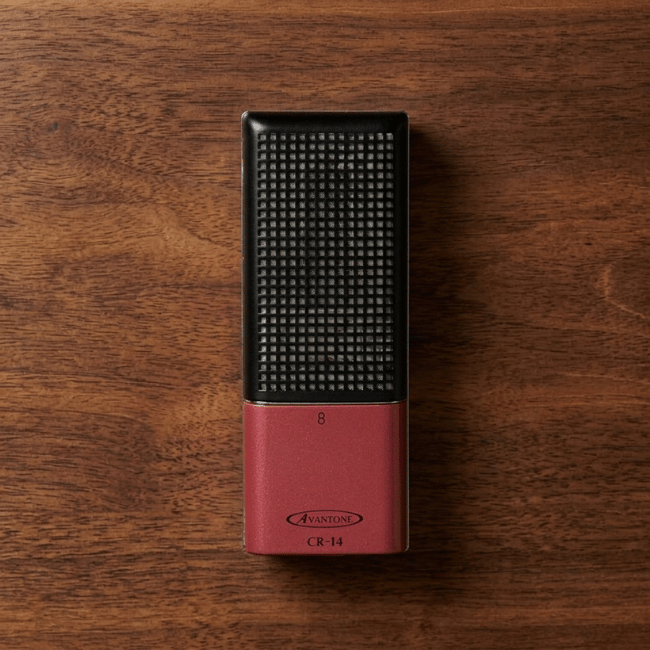
The Avantone Pro CR-14 is the microphone Avantone designed to answer a very specific question: Can you deliver the smooth, vintage sound quality of a high-end ribbon at half the cost? The answer is a qualified yes — and the engineering choices Avantone made to get there are worth understanding.
Technical Breakdown
The CR-14's core architecture is a dual-ribbon design using two low-mass pure aluminum ribbon elements, each measuring 35mm × 5mm at 2 microns thick. Unlike single-ribbon designs, the dual-element topology increases both sensitivity and output level — and crucially, it creates a larger "sweet spot" on both the front and rear sides of the figure-8 polar pattern, making mic placement faster and more forgiving. Maximum SPL is rated at 145 dB @ 0.5% THD. Output impedance is ≤600Ω with a recommended load of 3,000Ω. Sensitivity is -52 dBv re. 0 dB=1V/Pa. The entire housing — chassis and internal components — is precision-machined brass, finished in the distinctive Cabernet wine-red with nickel plating.
One important structural note: the front and rear sides of the CR-14 produce measurably different sound signatures — the asymmetry of the internal transformer and dual-ribbon alignment creates tonal differences between the two pickup faces. This makes the CR-14 unsuitable for mid-side (M/S) recording applications where front-back phase and frequency symmetry is required, but it gives the engineer two distinct tonal options from a single microphone position.
Acoustic Profile
The CR-14's frequency response runs 30 Hz – 15 kHz ±3 dB, which reflects a deliberate lower-midrange coloration that imparts immediate "vintage character" to modern digital recordings. The low-mid frequencies are rich and present, bringing warmth and density to sources that are often rendered thin or harsh in digital production chains. High-frequency detail rolls off gently above 10 kHz — intentionally smoother than a condenser. This makes it a powerful tool for rounding out harsh electric guitar tones. Due to the CR-14's excellent sensitivity to air movement, a quality pop filter is mandatory for vocal tracking. Ships with a custom retro shock mount, spare ribbons, and an elegant padded wood case.
Best Suited For
- ✅ Woodwind instruments (flute, clarinet, saxophone)
- ✅ Clean jazz and studio vocals
- ✅ Rounding out harsh electric guitar and amp tones
- ✅ Acoustic guitar, violin, and cello
- ✅ Brass instruments at moderate SPL levels
5. Golden Age Project R1 MK2 — Best Entry-Point for High Sound Pressure Levels
Golden Age Project R1 MK2 Ribbon Microphone
Best Ribbon Microphone Under $200 — Highest SPL Rating on This List
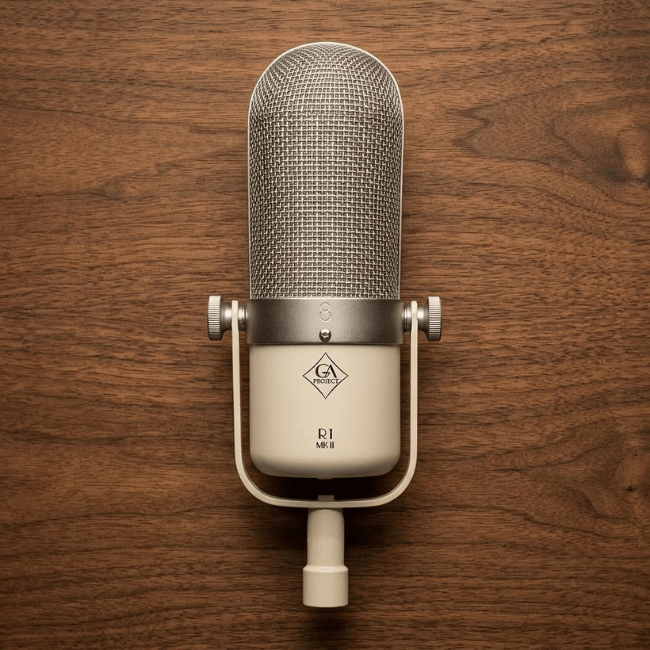
The Golden Age Project R1 MK2 delivers one of the most surprising specifications-per-dollar ratios in the ribbon microphone market. At its sub-$200 price point, it offers a maximum SPL rating of 160 dB — the highest of any microphone on this list, and a figure that competes with microphones costing five times as much.
Technical Breakdown
The R1 MK2 is built around a 50mm long ribbon made of 2-micron-thick aluminum foil — a relatively large ribbon geometry by modern standards. The heavier 2-micron aluminum construction is the key to its extraordinary SPL tolerance. Thicker aluminum foil can absorb greater energy from high-SPL sources without the ribbon element stretching, folding, or snapping under pressure. This physics-based design advantage directly enables the 160 dB SPL @ 1% THD rating. Output impedance is 600Ω with a recommended load of >3,000Ω. Sensitivity is -52 dB @ 1 kHz. An internal shock mount isolates the ribbon and magnet assembly from the body. It ships with a removable XLR cable and a soft transport case — the inclusion of the cable being a meaningful advantage over cheaper competitors.
Acoustic Profile
True to its name, the R1 MK2 delivers a classic 1940s–1950s broadcast ribbon tone: rich, dark, and deeply colored with substantial low-frequency weight. The frequency response extends from 30 Hz to 18 kHz, but the character is warm and mid-forward in a way that makes it immediately flattering on broadcast-style vocal performances requiring deep, authoritative low-end presence. This sonic coloration — the "golden age" of radio and studio recording — smooths out sterile, over-bright digital inputs in a way that can take considerable EQ work to achieve otherwise. For vocal recording in a home studio, this character can be a significant asset when working with naturally thin-sounding rooms.
Best Suited For
- ✅ Live room orchestras and large choral groups
- ✅ Loud horn groups and brass sections at extreme SPL
- ✅ Broadcast voiceover and podcast production requiring warm low-end weight
- ✅ Acoustic instruments requiring vintage coloration
- ✅ Electric guitar amplifiers at moderate-to-high volume
6. MXL R144 Heritage Edition — Best Ultra-Budget Ribbon for Home Studios
MXL R144 Heritage Edition Ribbon Microphone
Best Ribbon Microphone Under $100 — Ideal Entry Point for Home Studios
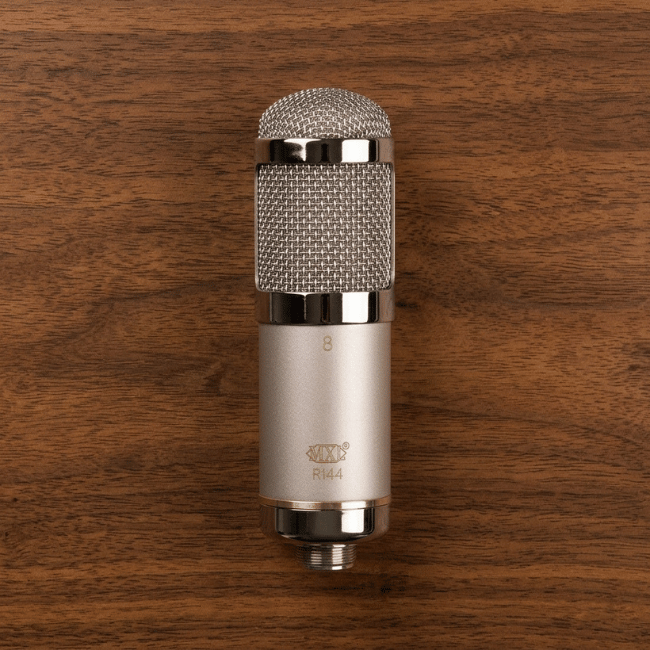
Finding a genuinely functional ribbon microphone at the sub-$100 price point is rare. The MXL R144 Heritage Edition Ribbon Microphone occupies a unique position: it is the most accessible entry point into ribbon microphone technology available for home studio recording, offering a legitimate learning platform for engineers who want to develop their ribbon mic technique without a significant financial investment.
Technical Breakdown
The R144 Heritage Edition uses a 1.8-micron, 47mm aluminum ribbon element — the same thickness as the much more expensive Rode NTR — matched to an internal transformer voiced for smooth, accessible tonality. The microphone outputs at -56 dBv sensitivity into a 250Ω impedance. Max SPL is rated at >130 dB @ 1 kHz with 0.1% THD. Frequency response spans 20 Hz – 17 kHz. The figure-8 polar pattern produces approximately equal sensitivity from front and rear, with sharp rejection at the 90° null points. The Heritage Edition cosmetic refresh adds a Silver Frost body and chrome grill over the original R144's design, along with a matching Silver Frost shock mount, padded carrying case, and cleaning cloth.
Acoustic Profile
The R144 HE exhibits noticeable top-end attenuation compared to modern active ribbons — the high-frequency response begins rolling off meaningfully above 12 kHz, which gives it a darker, rounder tonal character. Mid-range frequencies are relatively forward and present, which makes it an effective tool for sources that suffer from excessive brightness: over-bright condenser vocal tracks, sharp electric guitar tones, and aggressive high-hat recordings all benefit from the R144's natural darkening effect. The bottom end is warm and present without the deep broadcast weight of the Golden Age R1 MK2. Its primary value proposition is educational: the R144 teaches proximity effect management, figure-8 placement technique, and passive ribbon gain-staging at a price point that removes the financial anxiety from the learning process. It is also a proven choice for bedroom studio guitar tracking and home voiceover production.
Best Suited For
- ✅ Bedroom studio and home studio guitar amp tracking
- ✅ Home voiceover and podcast production
- ✅ Taming overly bright vocal profiles
- ✅ Learning ribbon mic technique and proximity effect management
- ✅ Horns and brass at moderate SPL
Important: As a passive ribbon microphone with -56 dBv sensitivity, the R144 is among the lowest-output microphones on this list. It will almost certainly require an inline gain booster to perform well with typical budget audio interfaces. See the preamp section below.
Crucial Signal Chain Requirements for Passive Ribbon Microphones
The Preamp Problem — And How to Solve It
This is one of the most common failure points for engineers new to ribbon microphones. Most standard audio interfaces — including highly popular entry-level models — max out at approximately 50–55 dB of internal gain. Passive ribbon microphones like the Royer R-121, Avantone CR-14, Golden Age R1 MK2, and MXL R144 typically require 60–70 dB of clean gain to produce an optimal signal level. The result of insufficient gain is not silence — it is a signal contaminated with the preamp's own internal noise floor, heard as persistent hiss and high-frequency smearing that no amount of post-processing can cleanly remove.
The Solution: Inline Microphone Preamplifiers
Inline microphone preamplifiers — commonly called "mic activators" — are passive signal chain devices that insert between your microphone and your audio interface. They convert the +48V phantom power supplied by the interface into up to +25 dB of clean, transparent gain, boosting the microphone's output before it enters the interface's own gain stage. This allows the interface preamp to operate in its clean, low-noise mid-range rather than being pushed to its noisy upper limit.
The industry benchmark is the Cloudlifter CL-1, which uses patented Class-A discrete JFET circuitry to provide up to +25 dB of ultra-clean gain. Critically, the Cloudlifter does not pass phantom power through to the microphone — this makes it safe to use between any passive ribbon and any interface with +48V engaged. An alternative is the Triton Audio FetHead, which operates on the same principle.
| Device | Gain Boost | Phantom Safe for Passive Ribbons? | Circuit Type |
|---|---|---|---|
| Cloudlifter CL-1 | Up to +25 dB | ✅ Yes — does not pass +48V | Class-A JFET |
| Triton Audio FetHead | Up to +27 dB | ✅ Yes — does not pass +48V | JFET |
Long-Term Maintenance and Structural Preservation
Ribbon microphones are precision instruments. The aluminum element inside each one is measured in millionths of a meter. Treating them correctly extends their working life by decades; treating them carelessly can destroy the element in an instant. Follow these structural preservation protocols:
- 🔼 Always Store Vertically: Gravity is the silent enemy of ribbon microphones. A ribbon stored horizontally over time will sag under its own weight, stretching the element and permanently altering its tension, frequency response, and sensitivity. Always store ribbon microphones upright in their cases, capsule pointing upward.
- 🚫 Never Blow Into the Microphone: This applies to all microphones but is especially critical for ribbons. A directed air burst — even from a gentle breath — can generate enough mechanical force to fold, wrinkle, or snap the ribbon element instantly. Never blow into a ribbon mic to test if it is working. Use a signal generator or simply tap the stand lightly and watch for meter movement.
- ⚡ Audit Phantom Power Before Patching Passive Ribbons: Before connecting any passive ribbon microphone to a preamp or patch bay, verify that +48V phantom power is fully discharged and switched off. Even a brief phantom power surge through a passive ribbon element can destroy it. This is non-negotiable: always connect the cable first, then engage phantom power only if required (and only for active ribbons).
- 💨 Use a Pop Filter for Any Vocal or Wind Application: Plosive consonants ("P," "B," "T") generate focused blasts of air that ribbon elements are uniquely vulnerable to. Always use a quality pop filter or a metal pop screen when tracking vocals or any source with significant air movement through a ribbon microphone.
- 🌡️ Avoid Extreme Temperature and Humidity Shifts: Unlike condenser microphones, ribbon elements are largely unaffected by humidity (one of their historical advantages). However, extreme temperature swings can affect transformer coil integrity and mechanical housing tolerances. Allow microphones stored in cold environments to reach room temperature before powering up or recording.
- 🔧 Never Attempt DIY Ribbon Replacement Without Training: If your ribbon element is damaged, send the microphone to a qualified service center. Replacement ribbon material is measured in microns — positioning it within the magnet gap requires specialized tools and trained hands. An amateur re-ribbon job will almost always produce worse results than the original and can cause further damage.
Interactive Ribbon Mic Selector: Find Your Match
Answer two quick questions to find the ribbon microphone that best matches your studio setup and recording goals.
🎙️ Which Ribbon Mic Is Right for You?
Step 1: What is your primary audio interface or preamp situation?
Frequently Asked Questions
Why are ribbon microphones so expensive?
Ribbon microphones are expensive because they are precision-assembled instruments — the aluminum ribbon element must be stamped, corrugated, and positioned within a magnetic gap measured in fractions of a millimeter, a process that is largely done by hand and requires highly trained technicians. Materials costs are also significant: rare-earth Neodymium magnets, custom-wound transformers, and high-grade aluminum foil all contribute. Premium models like the Royer R-121 carry a lifetime warranty and include complimentary re-ribboning, which factors into the price. However, budget models like the MXL R144 HE demonstrate that ribbon technology can be produced at accessible price points when manufacturing is optimized for cost.
Can I use an active ribbon microphone on a high-gain guitar amp?
Yes, but check the maximum SPL rating first. The Rode NTR is rated at 130 dB SPL — sufficient for most studio guitar cabinet applications but lower than the Royer R-121 (135 dB front face) or the Golden Age R1 MK2 (160 dB). For extremely loud, close-miked amplifier situations, a passive ribbon with a purpose-built high-SPL design — like the Royer R-121 or Golden Age R1 MK2 — is generally the safer, more appropriate choice. Never place any ribbon microphone directly in front of a ported bass reflex cabinet where high-velocity air movement from the port could damage the element.
What happens if I accidentally send phantom power to a passive ribbon mic?
Sending +48V phantom power to a passive ribbon microphone can destroy the ribbon element instantly — the voltage imbalance across the ribbon's connections causes a sudden, powerful electrical pulse that physically deforms or burns through the ultra-thin aluminum foil. In some cases, only partial damage occurs, resulting in degraded sensitivity and altered frequency response. Always verify that phantom power is switched off and fully discharged before connecting a passive ribbon microphone; wait at least 10 seconds after disabling phantom power before plugging in or unplugging any ribbon mic. Note that inline boosters like the Cloudlifter CL-1 do not pass phantom power to the microphone, making them safe to use in phantom-powered signal chains.
Do ribbon microphones wear out over time?
Yes, ribbon elements can gradually stretch and relax over years of use, causing a shift in tension that lowers sensitivity and alters low-frequency response — but this process is extremely slow under normal, careful operating conditions and may take many years to become audible. More immediate wear causes are improper storage (horizontal positioning that causes gravitational sag), accidental phantom power exposure, plosive air blasts, and physical shock. Most ribbon microphones, including the Royer R-121, can be professionally re-ribboned and returned to factory spec at modest cost — making them, with proper care, effectively lifetime investments.
Do I need a special preamp for ribbon microphones?
For passive ribbon microphones, you need a preamp capable of delivering at least 60–65 dB of clean gain with a high input impedance (preferably 1,500Ω or greater). Most budget audio interfaces fall short of this requirement, making an inline booster like the Cloudlifter CL-1 or Triton FetHead an essential purchase. For active ribbon microphones like the Rode NTR, standard interface preamps are sufficient. See our full breakdown in our guide on microphone preamps and whether you need one.
What is the best ribbon microphone for electric guitar?
The Royer Labs R-121 is universally regarded as the best ribbon microphone for electric guitar amplifiers. Its patented offset-ribbon design handles SPL levels exceeding 135 dB, its 2.5-micron aluminum ribbon naturally rolls off harsh upper harmonics above 10 kHz, and its low-end and mid-range response captures the fundamental character of a guitar amp without the fizz and digital harshness that condenser microphones can introduce. It has been the default guitar cabinet ribbon mic in professional US studios for over two decades.
Our Top Picks — At a Glance


Final Thoughts
Choosing from the best ribbon microphones available today is ultimately a question of matching engineering specifications to your studio's specific acoustic demands, signal chain capabilities, and budget. The Royer R-121 remains the definitive professional workhorse for electric guitar and brass — a mic that has earned its place on virtually every serious studio's microphone locker. The Rode NTR bridges the gap between ribbon warmth and condenser clarity for engineers who need extended frequency response from an active design. The Beyerdynamic M160 offers a uniquely directional solution for untreated rooms and legendary drum overhead applications. The Avantone CR-14 and Golden Age R1 MK2 deliver genuine vintage character at mid-range and entry price points. And the MXL R144 Heritage Edition proves that the ribbon microphone experience doesn't have to break the bank for the home studio engineer just getting started. Whatever your recording goals, a ribbon microphone will consistently bring warmth, natural transient behavior, and a musicality to your recordings that is difficult to achieve any other way. Invest in the right one for your signal chain, care for it properly, and it will serve your studio for decades to come.
Last update on 2026-08-20 / Affiliate links / Images from Amazon Product Advertising API